
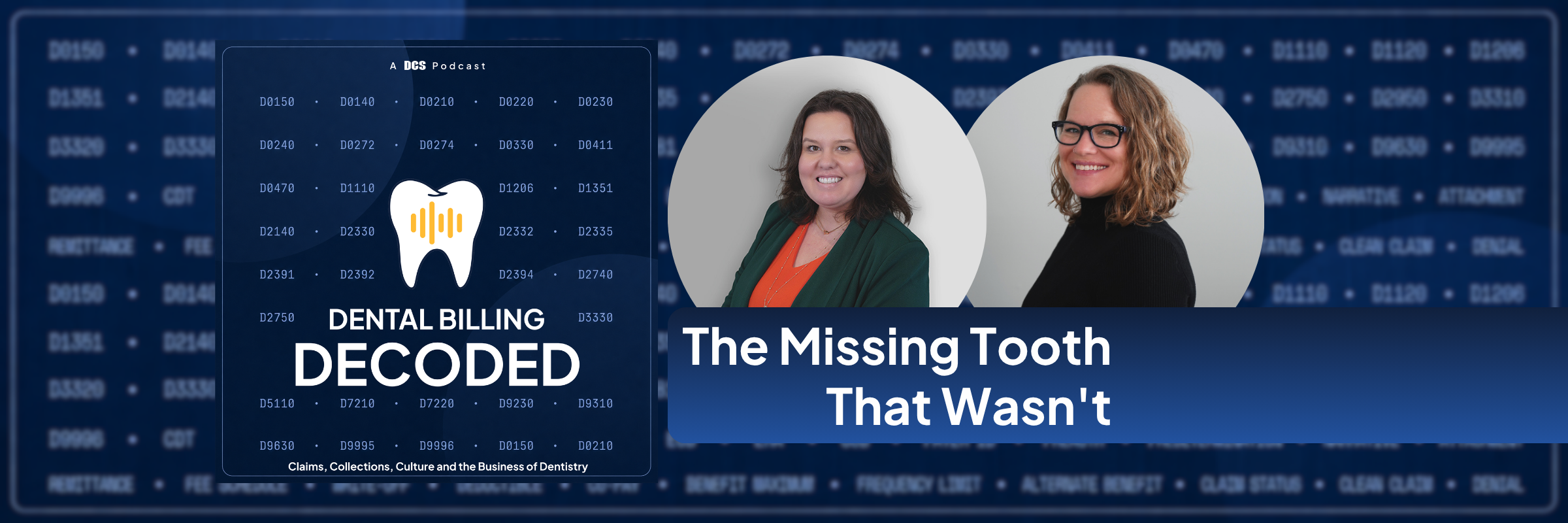


Dental insurance denials can be frustrating, especially when the denial seems to ignore the clinical reality of a patient’s situation. But a denial doesn't always mean the conversation is over. Hear what we mean in our latest podcast episode of Dental Billing Decoded.
Sometimes, a successful appeal requires digging into the details, documenting what happened, building a compelling case, and refusing to stop at the first ‘no.
In Episode 1 of Dental Billing Decoded, DCS Vice President of Business Operations Steph Neville sits down with DCS Marketing Manager and longtime dental biller and former office manager Jenna Hager to talk about some of the most difficult (and sometimes downright strange) claims they've encountered throughout their careers.
🎙️ Listen to Episode 1 of Dental Billing Decoded.
One major theme emerged from their stories: strong appeals aren't just about knowing dental billing rules. . They're about knowing how to build a case.
Here are six key takeaways from their conversation.
[[TOC]]
Takeaway #1: Don't assume a dental insurance claim denial is the end of the road
Jenna shared a story from early in her billing career involving a patient with severe periodontal disease who was scheduled for full-mouth extractions and an immediate denture. Before the scheduled extraction, tooth #8 fell out on its own due to the severity of the patient's periodontal condition.
The practice proceeded with treatment and submitted the claim. The insurance carrier denied the denture under a missing tooth clause because there was no extraction history for tooth #8.
At first glance, the denial appeared straightforward. The tooth was missing, and the carrier had no record of it being extracted. But the clinical documentation told a different story. The preoperative X-rays showed that the tooth was present when treatment was planned. The tooth was simply lost before the scheduled extraction.
Instead of accepting the denial, Jenna started looking for ways to prove what had actually happened. That meant going beyond the original claim and building a more complete picture of the patient's situation.
The lesson: A denial reason doesn't always tell the whole story. Before accepting a denial, review the documentation and ask whether the facts support an appeal.
Takeaway #2: Build a timeline for difficult appeals
When a claim has gone through multiple phone calls, submissions, denials, and appeals,the history can quickly become difficult for anyone reviewing the account to follow. Jenna explained that she would document important milestones, including:
- When the original claim was submitted
- When the claim was denied
- When an appeal was submitted
- Who she spoke with at the insurance company
- What the representative said would happen next
- Reference or confirmation numbers
- When she followed up
- What happened (or didn't happen) after the follow-up
Putting those details in writing creates a clear record of the practice's efforts to resolve the claim. . It also puts the history of the claim directly in front of the person reviewing the appeal.
The lesson: Don't make the insurance company reconstruct the history of a complicated claim. Give them the timeline.
Related: 5 simple tips to win the dental insurance claim appeals battle [Free guide]
Takeaway #3: Use every piece of relevant documentation
A strong appeal may require more than one piece of supporting documentation.
In the missing-tooth example, Jenna went back to the patient to find out what had happened to the tooth. She obtained a written statement from the patient, along with a narrative from the dentist, and included the relevant claim history.
Together, those pieces of documentation created a much stronger argument than the original claim alone. This is particularly important when the circumstances surrounding treatment don't fit neatly into an insurance company's standard claim-processing rules.
Consider the difference between saying:
“The tooth was missing before the procedure.”
and demonstrating:
- The tooth was present on the preoperative X-ray.
- Treatment was planned while the tooth was present.
- The tooth became severely mobile because of the patient's periodontal condition.
- The patient reported that the tooth fell out before the scheduled extraction.
- The dentist documented the circumstances.
- The practice followed up with the insurance company and appealed the denial.
The second approach tells the complete story.
The lesson: When the circumstances are unusual, thorough documentation can help turn an incomplete claim story into a more compelling appeal.
🎙️ Hear the full story in Episode 1 of Dental Billing Decoded.
Takeaway #4: Look beyond the surface of a missing tooth clause denial
Missing tooth clauses were a major focus of the episode, and the discussion highlighted an important point: there can be more to these denials than simply whether a tooth is missing.
Jenna described another successful appeal involving a patient whose tooth had been extracted while covered by a previous insurance carrier. The patient's employer later switched insurance carriers, meaning the patient moved to a different plan without changing employers.
The distinction mattered. The practice was able to demonstrate that the patient had maintained coverage through the employer and that the change in insurance carrier resulted from the employer's decision, not the patient's decision to change plans.
That information became the basis for an appeal, which ultimately resulted in payment. The takeaway isn't that every missing tooth clause can be overturned. Instead, it's that billing teams should investigate the circumstances behind the denial rather than assuming the clause automatically settles the claim.
The lesson: Every plan is different, so the specific policy language still matters. But understanding the history behind a claim can uncover information that may support an appeal.
Takeaway #5: Don't overlook the patient as an advocate
One of the most interesting points from the conversation was the role patients can play in resolving difficult insurance issues. The insurance company has a contractual relationship with the patient as the policyholder. Because of that, there are situations where a patient may be able to get information, clarification, or assistance that a dental office has struggled to obtain.
Jenna described regularly encouraging patients to contact their insurance carrier when appropriate and advocate for themselves.
In one case, a patient living in rural West Texas had an HMO plan but did not have an in-network provider anywhere near his home. He ultimately became his own advocate, involving the insurance company and his employer's HR department to explain the situation.
By advocating for himself and involving his employer's HR department, the patient was ultimately able to reach a resolution with the plan that allowed him to receive care. For dental practices, this doesn't mean simply telling patients, “Call your insurance company.”
Instead, the practice can equip the patient with information that helps them advocate effectively.
Give them the relevant details. Explain what happened. Help them understand what information may be relevant to the issue. Then give the patient the information they need to advocate for themselves with their plan.
The lesson: Don't underestimate the role a patient can play in advocating for their own benefits.
Takeaway #6: Remember that there's a person on the other end of the phone
Insurance calls can get heated. After spending hours working a claim, receiving another denial or speaking with an unhelpful representative can make it tempting to approach the next call with frustration. But both Steph and Jenna emphasized the value of maintaining a professional, friendly approach.
Jenna pointed out that insurance representatives are often dealing with frustrated people all day. Approaching the conversation with patience and professionalism can set the tone for a more productive interaction. That doesn't mean accepting an incorrect answer.
It means separating the problem you're trying to solve from the person you're talking to.
Jenna even shared a strategy she used when an insurance representative provided exceptional service: instead of asking for a supervisor because something went wrong, she would ask to speak with a supervisor to compliment the representative.
The lesson: Ask questions, explain the situation clearly, treat the representative respectfully, and when someone genuinely goes above and beyond, recognize their effort.
The bigger lesson: Know when a denial is worth another look
To recap, here are 6 key takeaways from episode 1 of Dental Billing Decoded:
- Takeaway #1: Don't assume a dental insurance claim denial is the end of the road
- Takeaway #2: Build a timeline for difficult appeals
- Takeaway #3: Use every piece of relevant documentation
- Takeaway #4: Think creatively about missing tooth clauses
- Takeaway #5: Don't overlook the patient as an advocate
- Takeaway #6: Remember that there's a person on the other end of the phone
The stories shared in this episode demonstrate why dental billing is about much more than submitting claims and posting payments. Insurance rules can be complicated. Patient circumstances don't always fit neatly into those rules. And sometimes the information needed to get a claim paid isn't included in the original submission.
That's why experienced dental billing teams need more than technical knowledge. They need persistence, critical thinking, strong documentation, communication skills, and the willingness to investigate a claim from multiple angles.
The next time a difficult denial lands on your desk, don't immediately ask, “Why did they deny this?”
Ask: “What information do I have that could change their decision?”
That shift in perspective can help you determine whether a frustrating denial is worth appealing. Need experienced support managing dental insurance claims, denials, and appeals? Book a call with DCS to learn how our dental billing experts can support your revenue cycle.

Related Posts
Dental revenue resources from Dental Claim Support