
Dental Billing Decoded Episode 4: Less Payment Chasing, More Patient Care


Insurance billing gets plenty of attention in dental practices, and for good reason. Between claim submissions, denials, follow-ups, and outstanding insurance balances, keeping up with insurance can feel like a full-time job. But there's another important part of the dental revenue cycle that deserves just as much attention: patient collections.
Collecting patient balances shouldn't have to mean printing stacks of statements, making repeated phone calls, and hoping patients eventually send a payment. Today's patients are accustomed to handling nearly everything on their phones, and dental practices have an opportunity to make paying for care just as convenient.
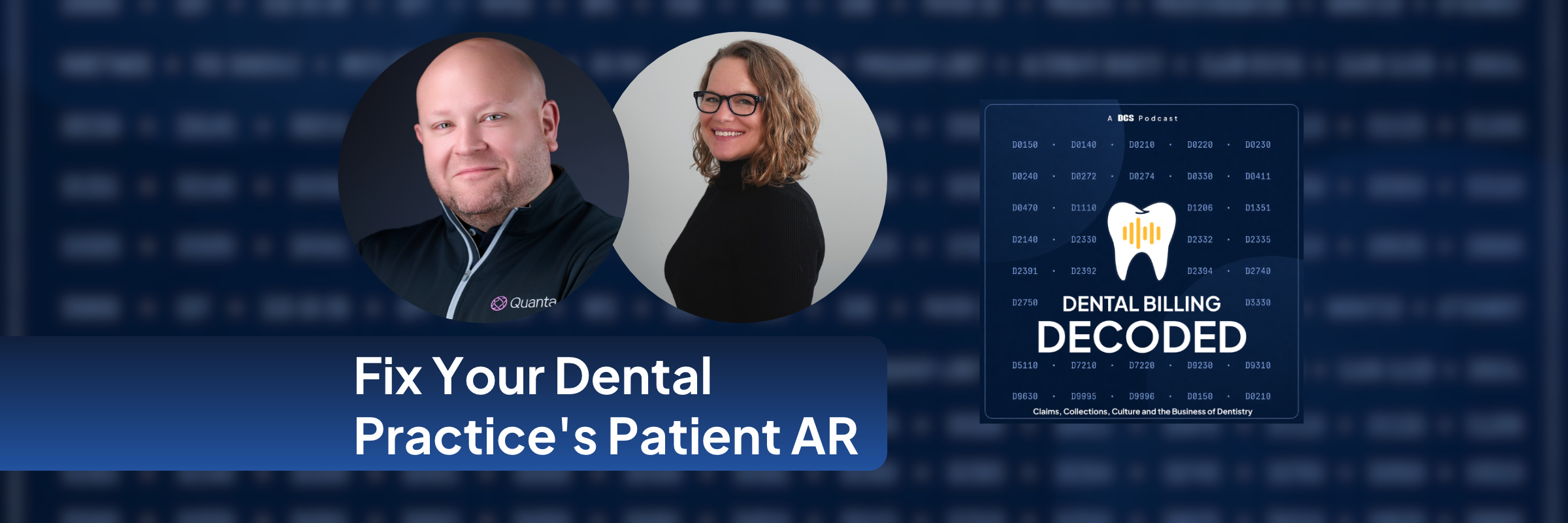
In Episode 4 of Dental Billing Decoded, host Stephenie Neville, Vice President of Business Operations at Dental Claim Support (DCS), sat down with Harry Levy, Senior Operations Manager at QuantaPay, to discuss how technology is changing dental patient collections.
[[TOC]]
Drawing on their experience in dental practice operations, they explored how automation, flexible payment options, and better communication can improve the experience for both patients and dental teams.
Here are five key takeaways from their conversation on improving dental patient collections.
Key takeaways: How can dental practices improve patient collections?
Dental practices can improve patient collections by making payments more convenient, reducing reliance on paper statements, offering flexible payment options, and using automation to simplify follow-ups. Clear communication and transparent balance information can also help patients understand what they owe while reducing administrative work for dental teams.
Takeaway #1: Patient collections are just as important as insurance billing
It's easy for patient collections to fall to the bottom of the priority list when insurance billing demands so much attention. However, patient balances are still part of your practice's revenue cycle, and overlooking them can create unnecessary financial strain.
As Harry pointed out, the way patients interact with businesses has changed. Consider how most people handle their mail. A paper statement might sit in the mailbox for several days before making it to the kitchen table, and then it could sit unopened for even longer.
Meanwhile, most people check their phones multiple times throughout the day.
Text messages and emails offer a more direct way to communicate with patients about outstanding balances. Rather than relying on a paper statement to prompt action, practices can send patients a convenient payment link that allows them to take care of their balance directly from their phone.
The goal isn't simply to collect faster. It's to remove unnecessary barriers between patients and the ability to pay.
Takeaway #2: Paper statements and phone calls aren't always the most effective approach
Traditional patient collection workflows often involve a predictable cycle: print a statement, mail it, wait, send another statement, and eventually call the patient. But as Steph and Harry discussed, this approach can create more work without necessarily producing better results.
Patients may not remember receiving a statement. Others may hesitate to provide credit card information over the phone because of concerns about scams and sharing sensitive information.
A secure payment link sent through text or email offers a different experience. Patients can review their balance and submit payment electronically without having to call the office or provide sensitive payment information over the phone.
And if a patient prefers a more traditional approach, that option doesn't have to disappear. The important thing is giving patients convenient ways to pay while reducing the administrative work required from the dental team.
Takeaway #3: Fee-for-service practices can benefit from payment automation, too
Payment automation isn't just for practices that participate in insurance plans or carry significant patient accounts receivable. Harry explained that fee-for-service practices can benefit from these tools in several different ways.
For example, patients may prefer to keep a payment method on file rather than tapping a card at every appointment. Parents may want to authorize payment for their children's appointments without having to be physically present. Practices with in-house membership plans may also benefit from automating recurring payments instead of managing everything through spreadsheets.
Related: Fee-for-service dental practices need a different collections strategy
The takeaway? Every practice has payment workflows that could be made easier, even if its patient collections process looks different from that of an insurance-based practice.
Takeaway #4: Make it easier for patients to accept treatment and pay for care
One of the most interesting parts of the conversation focused on treatment plan acceptance.
Steph shared a story from her time working in a dental office about a patient who arrived for a significant procedure, agreed to the treatment plan, and then realized they'd left their wallet in the car when it was time to pay. The patient left the office and never returned for treatment.
It's a frustrating situation, but it highlights an important point: payment barriers can affect treatment acceptance. QuantaPay offers treatment plan functionality that allows practices to present treatment options electronically. Depending on the practice's workflow and supported practice management software, treatment plans can be presented on an in-office iPad or sent directly to patients by text.
Patients can then accept treatment and choose how they want to pay. Options include:
- Paying the full amount upfront.
- Making a down payment.
- Setting up a payment plan, if offered by the practice.
- Connecting to an available third-party financing provider, such as CareCredit or Sunbit.
By making it easier for patients to understand their options and complete the payment process, practices can remove some of the friction that might otherwise stand between treatment acceptance and scheduling.
Takeaway #5: Personalization and transparency build patient trust
One potential concern with automated patient communication is that it could feel impersonal. But automation doesn't have to mean sacrificing the patient experience. Harry explained that QuantaPay integrates with supported practice management software (PMS), allowing practices to use relevant patient and payment information to support their collection workflows.
Practices can customize their communications to reflect their own branding, including their logo, colors, contact information, and office name. Text messages can come from the practice's existing office number, and emails can use an office-specific email address.
Read more: How transparency builds trust when discussing dental payment options
This matters because patients are increasingly cautious about suspicious messages and potential scams. Seeing a familiar office name and contact information can help patients recognize that a communication is legitimate.
The platform can also provide context about outstanding balances. Depending on the practice's integration, patients may be able to view details such as recent appointments, insurance payments, and adjustments.
Instead of receiving a statement with an unexplained balance, patients have more information to help them understand what they owe. That transparency may also reduce the number of calls coming into the front office from patients asking where a balance originated.
The bottom line: Better patient collections start with a better experience
To recap, here are five key takeaways from Episode 4 of Dental Billing Decoded:
- Patient collections are just as important as insurance billing
- Paper statements and phone calls aren't always the most effective approach
- Fee-for-service practices can benefit from payment automation, too
- Make it easier for patients to accept treatment and pay for care
- Personalization and transparency build patient trust
As Steph and Harry discussed, today's patients expect convenient ways to communicate and pay. Practices that continue relying exclusively on paper statements and phone calls may be creating unnecessary barriers for patients and additional work for their teams.
Technology can help bridge that gap through automated reminders, convenient payment links, flexible payment options, transparent balance information, and automated ledger posting where supported.
But the biggest takeaway isn't that dental practices need to automate everything. It's that they should use technology where it makes sense, while keeping the human connection that makes a great patient experience possible.
Want to hear the full conversation?
Listen to Episode 4 of Dental Billing Decoded as Steph Neville and Harry Levy discuss practical ways to simplify dental patient collections, improve payment communication, and give dental teams more time to focus on patient care.
Related Posts
Dental revenue resources from Dental Claim Support