



As a dentist, you spent years in school learning the ins and outs of oral healthcare. It was hard work, but you completed it, opened a practice, and now you’re tending to patients as you learned to do. But you’re also running a business, and that’s something they probably didn’t teach you in dental school.
Dental schools produce excellent clinicians…but not experienced businesspeople. And when you get your own practice, you are, in fact, signing on to be a businessperson.
When private practice owner Misako Hirota, DMD, was asked by Becker’s Dental and DSO Review what they thought was missing from dental school, they said:
“Business acumen. It would have been helpful to have some education in how to run a successful practice, as in what type of analytics we should be looking at on a daily, weekly, monthly, and yearly basis, how to handle HR issues, [and] how to analyze insurance plans.”
Dental school has a few blind spots when it comes to instructing their students on how to run a practice, and there’s a sizable learning curve to opening and running a thriving dental business.
And these gaps in your business knowledge can negatively impact your employees, your patients, and your overall revenue. But it’s not your fault that dental school didn’t include courses and classes on how to run a dental practice!
We hear about this from our client-partners, and we’re here to help you run the best dental business you can. So let’s get started on filling those business knowledge gaps with these 3 things you need to learn to run a profitable dental practice.
3 key takeaways on dentists running a profitable dental practice:
- It’s okay to ask for support if you’re not sure how to optimize your billing processes.
- A rock-solid administrative team is key to a successful dental practice.
- DCS billing-related services will help you increase collections while your team supports production.
Lesson #1. How dental insurance billing actually works
Dental insurance billing is a huge part of owning and running a dental practice, even if you are not in-network.
If you’re a fee-for-service dentist, you need to understand enough about how insurance coverage works to offer your patients accurate out-of-pocket estimates and answer their coverage questions about how much they could be reimbursed by their insurance.
For all dentists, there’s a lot to learn about insurance billing, including but not limited to:
- How insurance plans work (deductibles, maximums, dual coverage, etc.)
- Payer rules and regulations
- CDT coding protocol and annual changes
- State laws on how to record a provider on an insurance claim
- What’s required for an acceptable claim
- How to submit and manage appeals to denied insurance claims
This is just the highlights, but it is a solid beginning for what you and your administrative team must understand about dental insurance billing to effectively serve your patients and your practice. If you’re in-network, insurance claims account for close to half of your overall revenue, so you need to know how to get dental insurance claims paid fast.
What happens when you don’t know how dental insurance billing works?
- Bottlenecks in your collections process will delay claims filing and stall your cash flow.
- Claims will be denied due to errors leading to frustrated patients and revenue loss from unnecessary write-offs.
- Accounts receivable (A/R) will grow unchecked, resulting in a huge dip in overall revenue.
- Your team will dedicate hours to rework denied claims rather than tending to your patients.
How DCS helps you overcome dental insurance billing challenges:
The DCS dental billing specialists and revenue cycle management (RCM) experts provide long-term insurance claims filing with follow-up and also short-term A/R recovery to increase and stabilize cash flow while removing the insurance billing burden from your team’s shoulders.
If you have a backlog of claims to research and resolve for reimbursement, our A/R Special Projects team will get claims appealed and paid. This will reduce the mountain of accumulated claims work to a manageable maintenance mode for your team.
Or if you’d rather keep insurance claims off your team’s plate, you can keep us on to manage the claims process for your practice.
Lesson #2. High production doesn’t guarantee high cash flow
From what we’ve seen and heard in over a decade with dental insurance billing, dental school doesn’t emphasize the difference between production and collections. In short, a busy schedule doesn’t promise financial stability.
You can see hundreds of patients every year—or even every month—but if you aren’t efficiently collecting payment from them and their insurance, then you’re not getting paid for much of that 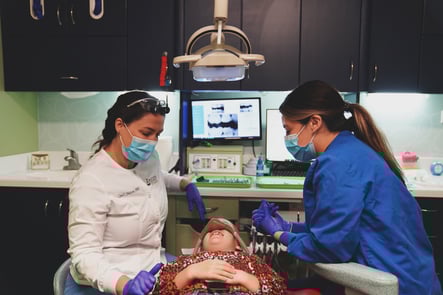 production. We know you became a dentist because you wanted to help people, and if you’re going to stay in business to do that, you must be paid for all your hard work.
What happens when you don’t have effective dental collections?
- You risk being overworked and underpaid.
- Your practice’s overall revenue will be notably lower than expected.
- Insufficient cash in hand will make it difficult to make payroll and upgrade equipment.
- Claims will become uncollectable as they age past timely filing deadlines.
- Patient accounts will become more difficult to collect from over time.
That may sound dire and scary, but that’s the reality of production with deprioritized collections. It doesn’t happen overnight. It’s a silent drain on your resources.
Read more: Celebrating Excellence: The DCS Impact on Dental Practices
How DCS supports consistent cash flow and reliable collections:
At DCS, our mission is to improve the lives of dentists and their teams through expertise plus technology to maximize revenue and support patient care.
Whatever your production or capacity, our teams are here to help you maximize your revenue by collecting every earned dollar from insurance and patients, as we have since 2012.
While your team focuses on getting patients in the door and shaping a winning patient experience, our team is in the background ensuring all your claims are paid promptly. With expert support, both your production and your collections can thrive.
Lesson #3. Practice growth requires ample skilled front-office support, not just more patients
Your administrative team is the heart of the dental office operations. You need capable, talented people to answer the phone, greet patients, manage the schedule, handle claims and collections, order supplies, and more. In fact, you should think of them as an operations team. Their efforts keep your office running every day and can help you grow your practice.
And no, when we say “grow your practice,” we don’t just mean adding locations. Business growth can also mean growing your patient base, and you’ll need a steady team to manage that growth, too. For example…
If you add a new insurance to your network to draw in more patients, that will increase the complexity of your claims processing. You need a dental billing person or service who can manage your claims no matter how many insurance providers you’re in-network with or how many new patients you have.
What happens when you don’t have a skilled front-office team?
- Delays in claims filing and claims that are never filed.
- A large number of claim denials because claims are incorrect or incomplete.
- A large number of write-offs as claims are lost to timely filing deadlines.
- Delays in patient payments due to inconsistent payment follow-up and patient outreach.
- Difficulty growing your practice because operations can’t support the current state.
If you don’t have a solid team of skilled professionals in place, your practice might struggle, or maybe chaos will ensue. Chaos in the dental office leads to staff turnover, which can increase overall stress for the remaining team members—and all of this will be noticed by patients.
How DCS provides day-to-day operational support to dental practices:
DCS Special Projects teams relieve growing pains with practice management software (PMS) system cleanups and aging A/R catch-up. DCS Insurance Billing specialists provide ongoing claims management, including filing, follow-ups, appeals, and aging report maintenance—your team only needs to create the claims, and we’ll take it from there. We also offer A/R-only or posting-only on an ongoing basis for task-based support.
If you prefer for billing to be managed by your in-house team, our RCM consultants can help refine your workflows so that claims processing is consistent and feels seamless.
DCS offers a suite of dental insurance billing options for practices of every size and type. It’s your choice based on your team and practice needs.
Read more: Which are the best dental billing companies? Here are 11 to watch
Dental school builds clinicians, Dental Claim Support helps build profitable dental businesses
To recap, here are 3 things you need to know that dental school didn’t teach you:
- Lesson #1. How dental insurance billing actually works
- Lesson #2. High production doesn’t guarantee high cash flow
- Lesson #3. Practice growth requires ample skilled front-office support, not just more patients
It’s never too late to learn something new about the business of dentistry. Even the most seasoned professional in any industry has a few knowledge gaps. And for everyone, continued success lies not just in filling these gaps, but also in asking for support or for guidance on how to improve.
DCS Insurance Billing and DCS Special Projects let dentists focus on care, leadership, and growth, and their admin teams focus on providing a stellar patient experience. We’re here to simplify and optimize your in-house processes, maximize your revenue, and free up your team to put their valuable time towards what matters most: your patients.
Get a free Collections Analysis today to see how well your practice is performing and where DCS might support you as a billing partner.

Related Posts
Dental revenue resources from Dental Claim Support